The history of Valldemossa
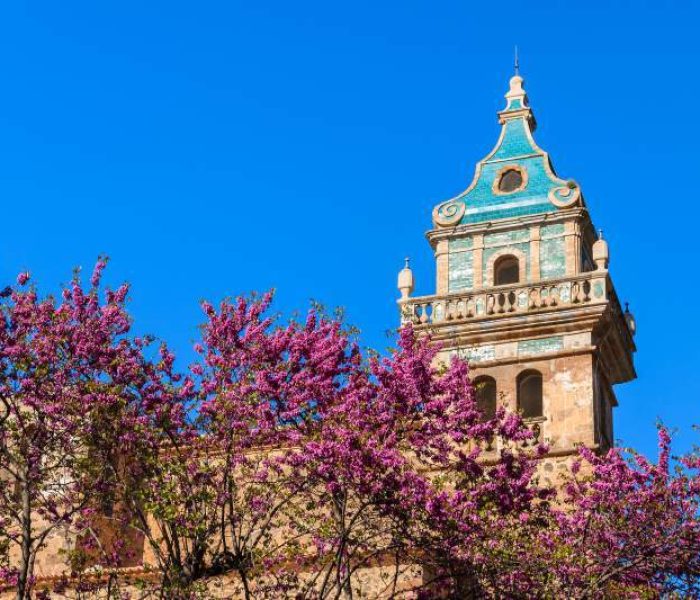
Valldemossa has been inhabited since the first people arrived on the island 3,000 BC. The natural landscape abundant of water sources has made it attractive for both hunting and agriculture throughout the centuries. Valldemossa is often times associated with prominent names such as Chopin, George Sand, Ludwig Salvator, Gaspar Jovellanos, numerous kings and even Hollywood stars like Michael Douglas. Moreover, Valldemossa is also the home of Mallorca’s very own saint, Catalina Tomàs i Gallard, a girl who was said to have spoken to the devil.
Below you can read the chronology of how Valldemossa has developed throughout history.
Table of Contents:
Prehistory and Talayotic culture
Roman epoch
Islamic rule
The Catalan conquest
The royal palace and monastery
Revolts, raids and segregation
Santa Catalina Tomàs
The 19th century
The 20th century and contemporary time
Prehistory
Along with the neighboring area of Esporles, Valldemossa is one of those areas in Mallorca that has the longest history of occupation which goes back to around 3,000 – 2,500 BC.
But a just an important fact about the Balearic prehistory, is the presence of the indigenous mammal known as the Myotragus Balearicus, a type of miniature mountain goat, presumably a result of phyletic dwarfism, an animal that through evolution had adopted to the island life. Fossilized feces, remains of horns and other bones was been discovered by William H. Waldren in the start 1970’s, in the Son Matge cave, which is meant to date from around 5,600 – 4,700 BC. The Myotragus Balearicus was extinguished by the time of human occupation, around 3,000 – 2,500 BC. There are multiple contradictory theories on whether the goat became domesticated post human occupation or if was already extinguished by the time of human occupation.
The two Balearic islands, Mallorca and Formentera, were presumably the two first of the four islands to see human settlements. At that time, most of the habitation was located in the eastern part of present day Valldemossa municipality. People lived in caves, both natural and artificial, as ell as used caves for burial sites. One of the most remarkable necropolises from this period is the cave of Sa Gravillera de Son Puig, located at the entrance to the s’Estret gorge. This early stage of habitation on the island was presumably a result of immigration of the Bell Beaker culture from Iberia and southern France.
In fact, Valldemossa is is one of those places on the Balearic Islands where most pottery from the Bell Beaker culture has been discovered in excavation projects. In both the cave of Son Matge and the settlement of Son Oleza, various pieces of the very distinguished ‘Boquique’ pottery was discovered. The type of Boquique pottery found in the sheltered cave of Son Matge has been assessed to be closely linked to the types discovered in the cave of Fonda, in Salomó, Tarragona. The exclusiveness of distinction of the design and methods used to make the pottery leaves no doubt of its origins. The pottery, with its distinctive shape of inverted bells and decorated with horizontal lines of various patterns, was used for naval trading, cultural trading or personal belongings as many graves has contained fragments of this type.
Another important site in Valldemossa that testify to the presence of the Bell-Beaker complex, is the Son Ferrandell-Oleza-Mas, a chalcolithic settlement estimated to date from around 2475-1300 cal BC (Waldren and Van Strydonck 1996). This site is of particular interest as it appears as a single cultural entity associated with the final phase of this culture.
Individual changes in design and technique has also helped archaeologist determine a chronology, that some of it was actually produced in this area and given a regional significance that would differentiate it from the Boquique pottery of the mainland. Some of the most interesting pottery found in Son Matge and Son Oleza from the Beaker culture dates from around 1750 cal BC.
In 1999, the dolmen of Son Oleza was discovered, a unique kind of burial site on the island of which only two other exist on Mallorca, the s’Aigua Dolça (Artà) and Son Bauló de Dalt (Ca’n Picafort, Santa Margalida). The Son Oleza dolmen is meant to be several hundred years older than other dolmens on the Balearic Islands. No less than nine different radiocarbon dates of the interior and exterior indicate the usage of this dolmen from circa 2200 BC to circa 1890 BC. Excavations of the dolmen shows evidence that it has been reused multiple time, cleared for human remains to make room for new burials. More than 43,000 fragments of artifacts has been found on the site, which include V-shaped buttons, wrist guards, copper awls, serrated flint blades and various pottery. Moreover, the Son Oleza dolmen is the only one on the archipelago to have contained Bell-Beaker pottery.
In the Balearic Islands, especially Mallorca and Menorca, a chalcolithic period (early Bronze Age) followed the Beaker complex. This early Bronze Age became known as the “Naviform” or “pre-Talayotic” period, as it was characterized by megalithic building constructions shaped like boats, and was from around 2,000 BC to 1,100 BC. However, people still lived in caves and used caves for burials , examples from this period include the caves of Pas de s’Escaleta, Es Foradins de Sa Coma, Son Matge, s’Estret de Son Gallard, Coves Negra, the sites of Sa Torre des Moro de Miramar, ses Cases de Son Mas, s’Esparengar,ses Rotes d’En Peloni, Puig de sa Moneta and finally the settlements of Es Rafal and Sa Tranca.
This period marks the entrance to an indigenous society of Mallorca.
From around 1,100 BC, the Talayotic culture appeared at the islands of Mallorca and Menorca. The Talayotic complex was characterized by the construction of tower-like buildings used for ceremonial and scouting purposes, either circular or square shaped. The Talayotic culture was a continuation or development of the prior pre-Talayotic and Naviform stage. A major crisis in the beginning of the first millennium BC caused by exhaustion of crops due to the lack of know-how on how to reproduce, divided the local communities of tribes in societal groups of wealthy and poor. The Talayotic culture lasted up until the Roman conquest in 123 BC, however, the construction of the Talayots (towers) already stopped around the 6th century BC. In Mallorca alone it is estimated that more than 500 Talayotic villages has existed with a demographic density of more than 40,000 inhabitants.
The name of the culture comes from the Catalan word “talaia” which means watchtower. The hilly and terraced terrain in the Tramuntana made it perfect for building such structures here.
In the municipality of Valldemossa, one of the most interesting and important Talayotic settlements are found, the one of Son Oleza-Son Ferrandell located in the most western valley. As already mentioned earlier, the dolmen of Son Oleza was already used in the Calcolithic and early Bronze Age several centuries prior to the Talayotic development. It is also important to point out that Son Oleza was too used for habitation during the Naviform period where it is assessed that several families lived here from around 1600 BC to 1300 BC. There is actually a 60-meter stone enclosure containing three naviform rooms.
In the Son Oleza-Son Ferrandell settlement you can see the remains of four circular talayots of which the first is known as “Talaiot del Dimoni”, all with a diameter of about 12. The settlement clearly display a series of four aligned round talayots connected with other constructions which all together outlines a ceremonial center used for various purposes, both religious, liaison and funerary.
Nearby, in the lands of the Son Mas property, the Talayotic inhabitants built a sanctuary solely for religious ceremonies. The sanctuary of Son Mas was used for animal offerings with libations of sacred liquids when the people worshiped their gods. Within the sanctuary multiple stones are lines up, which has been subject of much discussion between historians and archaeologists whether they were fundamental structures of a construction, if they were sacred stones. Regardless of theories, the Son Mas sanctuary is one of the most interesting and mysterious places representing the Talayotic culture in Mallorca.
The aforementioned cave of Son Matge, probably the most excavated cave on the entire island, was too reused during the Talayotic culture in Valldemossa. In Son Matge a Talayotic burial site was uncovered containing human remains covered with quicklime and a set of gifts and personal belongings. The most interesting find in this grave, however, was a bronze sword. The burials of Son Matge was related to a small Talayotic settlement that was discovered under the houses of nearby Son Brondo.
For all of the Talayotic structures found in Valldemossa it has been the same premise, they were built much more irregular than other constructions of that time due to the rough nature of the mountains. In other words, there was not any stoneware done.
With the Talayotc culture, a special and indigenous warrior of the Mediterranean was born, the Balearic foner. In history books the foners are simply called by their English term “slingers”, as their main weapon was slingshots. The foners were incredible hunters and warriors due to their abilities of being accurate and launch with great power. For this reason, they also offered their services as mercenaries and corsairs for the Phoenicians and later Carthaginians.
A total of 56 archaeological sites has been discovered and excavated in the local area of Valldemossa, with credits to Elviro Sans, Mascaró Pasarius, William Henre Waldren, J.F. Argente, Gaspar Pons Homar and Javier Aramburu-Zabala.
The Roman domination
In 123 BC, Roman general Quintus Cecilius Metellus led an expedition to the Balearic archipelago to end the continuing piracy that was still happening on these islands even after the fall of Carthage.
It was a prolonged process for the Romans to find the indigenous Talayotic people, however, not a match once found. With the Roman conquest of the islands, the Balearic archipelago entered western Mediterranean history as part of the Roman Republic.
The Romans, highly dedicated to naval trade and agriculture, founded two major urban area, Palma and Pol-lèntia, whereof the latter, located just outside the walls of present day Alcúdia, was the seat of political and economical power. The two locations were strategic, as these allowed the Romans to control the sea and continue their trading activities.
What’s interesting about the Roman era in Valldemossa, is that the Talayotic settlements such as Son Oleza-Son Ferrandell continued to coexist with the new Roman rulers. A lot of Roman amphorae, ceramics and coins testify to this. It is most likely that the Talayotic people agreed to a surrender that allowed for the mix. The Romans introduced agricultural techniques and completed what we know as the Mediterranean triad:
- Grains
- Grapes
- Olives
The Romans also engaged in other activities such as raising pigs, mining and stoneware.
To the Romans, the Balearic warriors were also great assets to their armies. Actually, Julius Cesar has mentioned and credited the Balearic warriors in his chronicles from the Gaul war around 57 BC.
But the strategic location of the settlements in Valldemossa also served the military objectives of the Romans who could easily keep control of the coastline.
The Roman chapter of Valldemossa more or less ended in the 5th century as the Western Roman Empire was falling. In the following century, Vandals looted the coastal areas of Mallorca, including Pol-lèntia, but nothing shows evidence of settlements by these.
Islamic rule
The annexation of the archipelago to the Emirate of Cordoba in 902-903, introduced a new culture and societal structure which came to mark the history of the island.
Following the capturing of the archipelago, almost without resistance, the capital of Madina Mayurqa was founded, with the construction of the Almudaina palace as the central seat of the Muslim governor, the walí. The city and harbor soon became one of the most prosperous in the entire Mediterranean due to the trading activities and piracy.
The Islamic population came from present day North Africa and the Middle East, mainly peasants. There was no need to organize the new society as the new population arrived in fully established and functional clans of kindred members.
Mallorca was divided in twelve administrative districts, so-called “ajzā”, in order to better manage and collect taxes. Valldemossa, Bunyola, Deià and the eastern parts of Esporles comprised the district called “Juz’ Musuh-Bunyula” (translated from medieval Catalan). The clans lived in farmsteads and cottages scattered in the green valleys of the mountains in “alquerias” and “rafals”, farms and huts respectively. The Islamic farmers introduced several new crops to the island such as artichokes, rice, bananas and figs, while at the same time continued raising livestock such as sheep.
More importantly, the Moors constructed hydraulic systems allowing them to irrigate the soil in an efficient way using water mills and pipes (quanats). They also built the stone terraces that you see on the mountain slopes in the valleys known as “marjades”, which are still in use and catalogued by UNESCO as part of the World Heritage program.
From the later Catalan conquest of the island, we know that the Moors typically named their farms and places of living after their clan name, a leader’s name or a descriptive name. The name of Valldemossa came of an Arab nobleman named “Mussa”, “Musuh” or “Muça”, who owned a great part of the lands in the area. According to the documents written after the Catalan conquest in 1231, the area was called “Wadi Muza” which was then translated to “Vall de Mussa” (Valley of Mussa).
The time of the Catalan-Aragónese conquest
In the years between 1229 and 1231, the king of Aragón Jaume I led a campaign to conquer Mallorca and the three other islands in the archipelago. The official reason for the campaign was to end piracy in the western Mediterranean basin, however, it is very likely that it was just as much a part of the great reconquista wars of the Middle Ages. Years before, in 1114, Barcelonian count Ramon Berenguer had led a retaliation campaign against Madina Mayurqa where the entire city was completely sacked and looted.
Nevertheless, King Jaume landed by the shores of Santa Ponca, Calvià, in the beginning of September 1229, with his 21,000 men and 150 ships. The following three months Madina Mayurqa was under a severe and brutal siege as the Catalan troops spared no lives as they made their way to the core of the city, the Almudaina. In December, all resistance in the city had been defeated and Mallorca was officially conquered. However, about 15,000 Moors had managed to escape to the Tramuntana and Llevant, two areas that were conquered the following two years. Madina Mayurqa was renamed to “Ciutat de Mallorca” (City of Mallorca).
Following the conquest of the island, Mallorca was divided among nobles, knights and church according to a promise Jaume had given in order to raise money and gather an army. Valldemossa, along with the areas of Bunyola, Esporles, Banyalbufar, Manacor, Sant Llorenç, Felanitx, ses Salines, Santanyí, Campos, Porreres, parts of Alcúdia and big parts of Ciutat de Mallorca, was given to Nunó Sanç, Count of Cerdenya and Roussillon, one of the main protagonists of the conquest and uncle of Jaume. After the death of Nunó Sanç, in 1242, his assets were transferred to the royal portion.
The events of the conquest and following division of the island was documented in the chronicles “Llibre del Fets” (Book of Facts) and in “Llibre del Repartiment de Mallorca” (Book of division of Mallorca).
The lands of Valldemossa was sold and rented out to new landowners in order to re-populate the area and claim taxes. Already in 1245, the first primitive church dedicated to Santa Maria was erected in the same place of the current church of Sant Bartomeu.
According to a promise of King Jaume the Conqueror given to the abbot of the royal monastery of Santa Maria de Poblet in Tarragona, the Cistercian monks was too granted property in Valldemossa. The monks built a small monastery overlooking the coastline from its position where 13 monks lived and studied. In 1276, following the inauguration of King Jaume II of Mallorca, famous philosopher Ramon Llull requested of the king that the property should be transformed into a missionary school of oriental languages and theology, in order to teach friars how to convert heathens. This was the foundation of the Miramar monastery.
The royal palace and charterhouse
The most emblematic landmark of Valldemossa is the Real Cartuja, or Real Cartoixa, a former royal palace and later Carthusian monastery.
The palace was originally built by the first monarch of the kingdom of Mallorca, Jaume II, son of Jaume I the Conqueror. Jaume II had a son named Sanç, or Sancho, whom suffered from asthma. Jaume II believed that the climate of the mountains would help relieve the asthma of his son, so he had a palace built and named after his son, Palau del Rei Sanç (Palace of King Sancho).
It is said that the palace was built on the site of a former Moorish fortress that belonged to the nobleman Mussa after whom the area is named. The works began in 1309 and was finished in 1321.
The castle was used by the royal families and came to have the primary function of hunting residence used by Jaume II, Sanç I, Jaume III and John I. The king’s room was found in the tower in the north side of the castle where the royal hall was also found. The queen’s chamber was found in the west side of the palace, in which famous artist, architect and carpenter Bernat Tarragó worked on the galleries.
In 1399, Martin the Humane converted the palace to the Carthusian monastery of Jesus of Nazareth (Valldemossa Carthusian monastery). The king had in 1385 participated in the opening of the charterhouse of Valldecrist, Valencia. Soon the monks began converting the great palace to a monastery transforming the parade yard to a cloister, as well as expanding the buildings as the old palace did not have the cell spaces required by the order. In 1446, the first church of the monastery was added.
The Carthusian monks had great impact on the social and cultural life of the people living in the area. In the Museu de Mallorca, in Palma, you can find a canvas done by Fernando de Coca displaying the foundation of Valldemossa with reference to the monastery.
Revolts, raids and segregation
The 16th century was marked by a series of terrible events, droughts, famine, raids and revolts, which eventually ended up depopulating Valldemossa quite a bit.
In 1520, a great revolt of artisans and countrymen had its outbreak in Mallorca. The tax pressure had tightened the grip of many people’s lives and made it difficult for them to subsist. At the same time, corruption of the crown and nobility kept a big societal gap in Mallorca, as many landowners of big farms lived in Palma and only paid taxes in Palma which, of course, left the countrymen in the rural areas with a higher tax pressure. In order to try and end this, a group of artisans started a movement to build a parallel society as seen several places on the mainland.
However, things soon turned ugly and a civil war broke out with malicious crimes being done against families, occupations of entire towns, assaults on the roads etc.. Mallorca was turned into a battle zone. This crisis ended in 1523, with the interference of the king sending his royal troops to the island to stop the rebellious movement. The consequences included hard repressions leading to depopulation of many areas, including Valldemossa. On top of that, a prolonged drought followed in 1523 making things even worse.
In 1552, North African corsairs landed by the beach of Valldemossa and made their way to the small town to raid it. Throughout the 16th and 17th century, the Balearic Islands faced the threats of the Ottomans trying to gain control of the western Mediterranean. However, in many situations the Mallorcan army managed to chase the corsairs away defending their towns which has left a pride in their cultural heritage and self-interpretation.
The raid of 1552 led to the erection of a series of watchtowers around the coast of Mallorca, as well as enhancements of buildings that would have platforms added on top of them. The Carthusian monastery had two towers added; Torre de l’Obediència (1553) and Torre dels Hostes (1555), which communicated with the watchtowers located on the coast and in the hills.
In 1583, the neighboring town of Deià segregated from Valldemossa, which until then had been under same administration. The request for segregation had been filed already in 1526 by the townspeople of Deià, but due to the many events and economical complications it turned into prolonged litigation of 57 years before the governor of Mallorca granted the segregation.
The depopulation of Valldemossa due to the crisis of these centuries was too felt by the church. Therefore, extra efforts had to be made in order to attract people to stay in the area and pray for better times. As a symbol of this effort, Jeroni Roig built the organ for the church which would give the sound reflecting the courage of those who stayed during these bad times.
Santa Catalina Tomàs
Just like the Carthusian monastery, you can not talk about the history of Valldemossa without mentioning Catalina Tomàs. She is the only saint born in Mallorca.
Catalina Tomàs i Gallard was born in 1521 into a poor family and was the youngest of seven siblings, who lost their parents in an early age. From an early age, Catalina is said to have recited lines from the Bible which she practiced in a corner of her grandmother’s house, by whom she lived with after the death of her parents. In fact, it was her grandmother whom exposed her to religion and imposed her to practice this.
At the age of 10 years, Catalina moved in with her uncle at the Son Gallard farm located between Valldemossa and Deià where she would help and work. Her devotion to religion clashed with her uncle’s beliefs on how she should spend her life, as he wanted her to marry and dedicate herself to peasantry and family rather than religion and life in a convent which was her dream.
Catalina suffered a hard time on the farm as her wishes for life were not respected. She would flee to the woods where she built altars and placed olive seeds as gifts and signs of devotion. In the woods practicing her religious vocation, Catalina is said to have had visions of several saints such as Catharine of Alexandria, Saint Bruno and Saint Anthony Abbot promising her the life as a nun one day.
One day, Fray Antonio Castañeda knocked on the family’s door willing to listen to young Catalina’s wishes. He was a former captain of the king’s army whom had retrenched himself living as a hermit at the Miramar hermitage. He was dedicated to a life helping other, and when he heard of the young girl, her vocation and dreams, he saw an opportunity to help. After a time of much effort, Castañeda had Catalina accepted in the convent of Santa Magdalena as a Lateran regular canoness of San Agustín, where she entered on November 13, 1552.
It was, however, with tears in her eyes she entered the convent as just a month before her grandmother had been brutally killed by corsairs during the raid in Valldemossa.
Catalina continued to have visions during her time in the convent making her a a popular figure amongst the nuns and abbess. She died three years after her last vision, around the feast of Catherine of Alexandria, on April 5th 1574, just 43 years old.
She was beatified on August 12, 1792 by Pope Pius VI, and proclaimed a saint on June 22, 1930 by Pope Pius XI.
The 19th century
In 1801, Spanish minister of justice and intellectual Gaspar Melchor de Jovellanos was removed from office due a number of disputes and sent in exile at the royal charterhouse in Valldemossa. The friars at the monastery was ordered to keep Jovellanos locked in his cell, in the old defense tower of the monastery, completely cut off from the outside world.
However, the friars at the monastery could not adopt to the role as prison keepers and soon allowed Jovellanos to walk freely on the property of the monastery, as well as supplied him with books, pencils and paper. The prior even sent a request to the court asking for his sentence to be reduced. He spent time studying botany and learned from the pharmacy of the monastery. He then composed his work “Tratado de botánica mallorquina o Flora medicinal de Valldemosa” (Treatise on Mallorcan botany or the medicinal flora of Valldemosa). In 1802, he wrote “Memoria sobre la educación pública o sea tratado teórico-práctico de enseñanza con aplicación a las escuelas y colegios de niños” (Report on public education or be a theoretical-practical teaching treatise with application to children’s schools).
Jovellanos repaid the generosity of the friars by paying for a number of books for their library, as well as paying for several part of the new church of the monastery.
In 1835, the First Spanish Carlist War broke out which had effects on the religious life of the town. In short, the conflict was rooted in the succession of the Spanish throne which after the death of Ferdinand VII had no male heir and therefore could not have a king. Ferdinand did have a brother though, Carlos de Borbón, and a daughter, Isabella. The clash stood between the supporters of Carlos and Isabella, hence the name of the war. Maria Cristina, mother of Isabella, acted as regent on behalf of her infant daughter.
The civil war against carlists and supporters of Isabella had major economical and cultural consequences for Spain, as the carlists supported an absolute power, conservative beliefs that a ruler should always be male and the church in governance. On the other hand, the supporters of the side of Isabella, still an infant, was pro a liberal line for Spain.
The war was expensive and to raise money to pay for weapons, supplies and soldiers, prime minister under Maria Cristina, Juan Alvarez Mendizábal confiscated monastic properties that did not make fully use of their arable land and sold them on auction to private investors. This act was called “Desamortización eclesiástica de Mendizábal” and included the charterhouse of Valldemossa. With this, the Carthusian monks were expelled from the town.
In the fall of 1838, Frederic Chopin and George Sand arrived in the Real Cartuja charterhouse looking for a place to relieve Chopin’s tuberculosis. The couple rented a cell in the monastery from it new private owner, cell no. 4.
However, the local townspeople of Valldemossa did not take kindly to the fact that the couple was not married, that Sand had children with another man, that they did not attend church service and that Sand smoked cigarettes and wore trousers instead of dresses. These things made the couple highly unwelcome and despised in the small town and as the weather did not help Chopin’s illness, the couple left in 1839. In 1841, George Sand published her work “Un hiver à Majorque” (A winter in Mallorca), a chronicle of their encounter with Valldemossa and its inhabitants.
In 1867, famous archduke of Austria Ludwig Salvator arrived in the area and began his expeditions to discover and uncover the natural environment of the Balearics which he was so fascinated of. Already in 1869, Salvator published his 6,000-pages work “The Balearics – Told in words and images”, a masterpiece based on his discoveries and acquaintances with the Balearic culture and nature. The work was dedicated to emperor Franz Joseph whom had granted Salvator the opportunity to skip military service and allowed his to pursue a scientific education. The work was awarded a gold medal at the 1878 World Exhibition in Paris.
Salvator was an adventurer attracted by the nomad lifestyle that he could outlive on his steam yachts “Nixe” and “Nixe II”. He was particularly interested in the nature of the Mediterranean and places that were more or less undiscovered, including the Balearics.
Over the following 30 years Salvator purchased properties in Deià and Valldemossa, constructed paths in the hilly terrain and set up free guest lodging to allow visitors to come and experience the picturesque area. Salvator ended up owning properties over a 16 kilometer stretch along the coast. However, despite of his wealth and many properties, Salvator was a humble and genuine person who did not dress nor acted as a nobleman, but rather as a peasant mingling with the local inhabitants wherever he came about. His behavior and approach allowed him to examine the true Balearic culture, the customs, traditions and lifestyle.
Some of the most emblematic properties acquired by Salvator was the Son Marroig in Deià, the Miramar in Valldemossa and the s’Estaca also in Valldemossa. The house of s’Estaca was designed by himself based on inspiration from the Liparian Islands. This estate he gave to his lover, although not officially confirmed, Catalina Homar, a daughter of a local carpenter. Homar came under the wings of Salvator from whom she learned multiple languages, as well as became administrator of his many adjacent vineyards where the two grew the sought for Malvasier grapes.
The 20th century and contemporary time
The 20th century started out good for Valldemossa, namely because of the beatification of Catalina Tomàs i Gallard by Pope Pius XI in 1930. The same year the bell tower and main facade of the Sant Bartomeu church was finished.
The Spanish Civil War (1936-39) and the following repression of the Franco regime limited the practicing of Mallorcan culture in the town. However, in 1943, the small Hotel Artista Chopin was purchased by local entrepreneur Bartomeu Estaràs Lladó, whom had a dream of creating a special place in the mountain town. He renamed the place to Hotel de l’Artista, and managed to create a hub for artists who stayed here in the picturesque mountain town from where they had optimal conditions for finding inspiration and serenity. The hotel became a protagonist in the local history of tourism, and has accommodated many famous personalities such as Coll Bardolet, Merle Oberon, Camilo José Cela and Ahn Eak-tai.
In the first third of the century Estaràs also started the music and dancing group Parado de Valldemossa, a group dedicated to folk dancing and folk music of Mallorca that often performed at the Hotel de l’Artista. In the 1950’s the group Los Valldemossas was founded which helped stimulating the local culture in a time when the regime was still strict.
The economical decline of the country during the repression had left many parts of Spain in poverty struggling to subsist. But from the late 1950’s, and especially during the 1960’s, the great tourism boom arrived in Spain giving rise to a whole new economy. Valldemossa too felt the impact of the new leisure economy, namely with the road between the town and Palma. The urban core was too expanded in the 60’s, as many people from the mainland arrived on the island to take jobs in the new industry.
Since the 1960’s, Valldemossa has primarily been dedicated to tourism.
In 1989, actor Michael Douglas and his wife at that time Diandra Luke purchased the magnificent estate of s’Estaca, former property of Archduke Ludwig Salvator. Douglas also purchased and initiated the Costa Nord cultural center in the heart of the town, which he sold to the Balearic government in 2004. His effort awarded him the nickname “Miquel de s’Estaca”.