History of Andratx, Mallorca
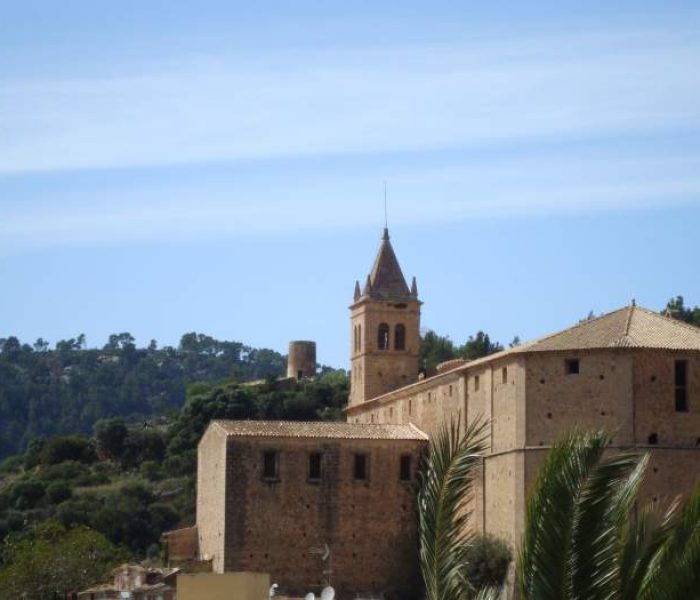
Find out how Andratx has developed from prehistoric times to a modern day tourism destination
Andratx is a municipality in the region of Tramuntana, located in the westernmost part of Mallorca. There are roughly five population centers within the municipal border, Andratx, Port d’Andratx, s’Araccó, Sant Elm and Camp de Mar, which together comprise about 11,300 inhabitants (2019).
History of Andratx
Prehistory
The origin of human occupation in the area of present day Andratx dates from the early Bronze Age. Some of the first vestiges found and excavated in the area are the caves of Son Bosc and Son Fortuny.
From around 1500 BC, the pre-Talayotic culture arrives in Mallorca and Menorca, an agricultural society that transitioned from caves to constructions. In Andratx, there has only been found one site that represents this period, namely the Son Basses which testify to this culture of vessel-shaped constructions for habitation.
Later, around 1100 BC, the Talayotic cultures arrived in Mallorca and Menorca, a culture unique to these two islands. The Talayotic culture got its name because of the tower-like constructions these people built, in Catalan talaia means “lookout” or “watchtower“. The Talayotic culture was too an agricultural society, but a clear sign that the islands were starting to get inhabited by people arriving from other places, because there was this need to build military architecture for scouting. The best known remain from the Talayotic culture in Andratx is the one of Biniorella, found near the current golf course. But there has also been discovered remains at Son Fortuny and Es Castellàs in the village of s’Arracó.
During the late Bronze Age, colonizers from the ancient Greek world and Phoenician culture started to arrive on the islands. These highly productive and active producers and traders mixed with the indigenous peoples, probably taking many of them as slaves to work in their textile factories and for oaring on the ships. The Phoenicians had a predilection for coastal areas and islands, as it made it easier for them to engage in trading with other colonies in the Mediterranean basin, for example the Greek colony of Empuries in present day Girona, Catalonia. The Phoenicians also knew about the minerals and metals in the ore-belt, that extended in the southern part of the Iberian peninsula, which allowed them to produce jewelry and burial gifts. Along the coasts of Andratx, wrecks of vessels, ceramics, anchors and other artifacts from this time has been found.
The mix of Phoenicians and indigenous peoples also increased the military mindset of the islands. The before mentioned Talayotic constructions were enhanced and walled enclosures were constructed around them to form fortified villages. Some of the greater examples of this is seen in the sites of Ses Païsses, s’Illot, s’Hospitalet Vell, Capocorb Vell and Son Fornés.
The military-oriented mindset also gave rise to training of warriors. Particularly one kind of warriors became emblematic of these islands, the Balearic foner. The foner, was a slinger shooting slingshots that was highly trained in accuracy and firepower which caused great damage to his enemies. The slinger became a great asset to the Phoenician troops, in fact, Hannibal the Great has been cited in multiple chronicles to give extra credit to these warriors during the wars in Sicily.
The Roman conquest
Following the fall of Carthage, in 146 BC, most of the Mediterranean region was annexed into the Roman empire. In 123 BC, Roman general Quintus Cecilli Metellus managed to also capture these islands, an accomplishment that gave him the title of consul and the nickname “Balearicus”. At that time, the island was still occupied by Phoenicians, the slingers had made it almost impossible to approach it as they could sink the Roman boats from the shorelines. However, as a stroke of genius, Metellus strapped pieces of leather around his ships that functioned as shields that could resists the stones and projectiles of the slingshots.
After a prolonged period of hunting down the indigenous warriors and fining the many settlements, the Romans could finally call themselves victorious. They built the first two cities in Mallorca; Palmera and Pol-lèntia (Palma and Alcúdia respectively), whereof the latter became the capital. The Balearic slingers were continued in the Roman army due to their amazing techniques. In the Gallic Wars between 58 BC and 51 BC, Julius Caecar is too cited in chronicles to give special credit to the slingers which would ride along with the elite troops.
As the Western Roman Empire started to decrease and eventually fall around the 4th and 5th century, the island entered a stage known as “the obscure centuries”, a period that lasted until the 10th century and was marked by settlements and raids from many different cultures. The first to arrive after the Romans were the Vandals who sacked the capital of Pol-lèntia and other settlements, but quickly disappeared again.
The obscure centuries
In the 6th century, Apollinarius, Byzantine general and governor under Justinian I, captured the eastern part of Mallorca. Some of the remains that testify to this, are the paleo-Christian basilicas Son Peretó and Sa Carrotja found in the municipality of Manacor.
The Moorish dominance
In 902, the Balearic archipelago was conquered by Moorish general Issam al-Khawlani whom annexed the islands under the Emirate of Cordoba ruled by the Umayyad Caliphate. Later, in 1015, the archipelago became part of the Emirate of Dénia. During the entire Moorish rule (902-1229) the Balearic Islands were know as illes Orientals de l’Àndalus.
With the new Moorish rulers, the island saw a great increase in prosperity as new fruits were introduced in the agriculture, it was convenient to do naval trading, and, piracy raids against Christian ships could easily be launched from the porto of Madina Mayurqua (Palma). Moreover, the island was introduced to a fiscal system that made it possible to construct mosques, baths, water supplies etc. The island was roughly divided in twelve administrative districts, each known as a “Juz” (plural. ajzā), whereof Andratx was part of the Juz d’Ahwaz al-Madina district, which also included current municipalities of Palma, Calvià, Esporles, Marratxi, Puigpunyent, Banyalbufar and Estellencs.
The Moorish agricultural communities formed in farmsteads and cabins scattered all over the countryside, however, there were signs of minor villages or at least a collection of buildings. A such example was the case of Andratx, where remains of Moorish houses and even a mosque in the area of present day street of Carrer de Estrella has been discovered.
One of the characteristics of the Moorish communities was that they lived in kindred groups and that they typically named their places after their clan or tribe. Typical place names would include prefixes such as banu, beni, bini, which translated into early medieval Catalan language, means “children of”. In Andratx, the Biniorella is a great example of a Moorish farmhouse that could have belonged to the ‘Orella’ clan. Other places that carry a Moorish heritage include Banyalbufar, Biniamar, Binibona, Binissalem etc. Of other Moorish places in Andratx, it is worth mentioning Buendar, Ator, Tor and Salmanoir.
The Catalan-Aragonese conquest
In 1229, Mallorca was conquered by troops led by King Jaume I of Aragón. About 21,000 infantry and horsemen landed on the shore of Santa Ponca, Calvià, from where they made their way to the capital. Actually, before the embarking in Santa Ponca the troops had stayed for a short while by the island of Pantaleu to scout and get familiar with the coast. After a brutal siege of three months, the Moorish walí (governor) Abu-Yahya surrendered the island to the king.
Jaume had made a pact with lords, knights, counts and church to distribute parts of the island among the participants of the campaign once successful. It was the bishop of Barcelona, Berenguer de Palou, whom was granted the area of Andratx along with Marratxi, Calvià, Puigpunyent, Estellencs, Prat de Sant Jordi (area in the eastern part of Palma) and the parish of Santa Creu of Palma. The division of the island was documented in the Llibre del Repartiment de Mallorca (Book of Distribution) and the kingdom of Mallorca was a reality.
The new Christian settlers were busy repopulating the island and rented out land to newcomers and soon a congregation grew in this area which gave rise to the first church of Santa Maria de Andratx mentioned already in 1248.
In 1323, a treaty called the “Pariatge” between the bishop of Barcelona and King Jaume III of Mallorca was signed, which divided the lands of Andratx between them.
In 1276, Jaume II inherited his fathers kingdom. Already in 1279, he ordered a hospital and chapel build under protection of Sant Elm. Both hospital and chapel was dedicated to fishermen and sailors.
The revolts of the modern age
The modern age was marked by two dark chapters in the history of Mallorca; the Revolta Forana (1450-1452) and the Revolta de les Germanias (1520-1523). Both were uprisings against the corruption of the ruling classes, first the farmers and small landowners, and second, the artisans guilds.
The Revolta de les Germanias (Revolt of the Brotherhood), which turned into a regular civil war, had significant consequences for Andratx, as especially the powerful Son Fortuny family was subject to terrible crimes by the ruthless rebellions. Many nobles who could not escape the area took refuge in the Son Mas estate.
Following the intervention of King Carles V, a hard repression was put on those families who had participated on the side of the agermanats.
The pirate raids
From around the mid-16th century, the Ottoman empire started attacking the Balearic archipelago. The first sign of the threat from the east was the sacking of Mahón, Menorca, when the town was completely destroyed and more than 6,000 people were taken as slaves, including women and children. The Ottoman fleet was commanded by some of the most legendary naval commanders; Heyreddin Barbarossa and Dragut, and was allied with North African corsairs who assisted in attacking the island.
The pirate raids against Andratx became frequent and brutal, some of the most ferocious attacks happened on August 24th, 1553, August 2nd, 1578 and on June 9th, 1643. Particularly the raid of August 2nd, 1578, came to mark the history and heritage of Andratx. According to the legend, it was the women of Andratx, who by the mediation of the Virgin of Angels, was given the strength to fight the corsairs making them leave the town. This brave and heroic act of the women is commemorated every year on the exact date with a great ceremony where women are collected on donkeys, parading through the old town and worshiped with songs, flower offerings and dances.
During the period between the end of the 15th century and the 17th century, many of the buildings in Andratx was fortified such as the Santa Maria church and Son Mas estate. It was also in this period and because of the many pirate attacks that multiple watchtowers were erected around the coastlines of Andratx, Sant Elm and on the Dragonera island, as well as in the town. The watchtowers guarded the coast and whenever an enemy vessel was spotted, the towers communicated via smoke signals and flags until the signal reached the town. Some great and still preserved examples of these watchtowers are the ones of Llebeig (Dragonera island), Sant Carles/Sa Mola (Port d’Andratx), Castell de Sant Elm, bell tower of the Santa Maria church, the Sagrament tower of the Son Mas estate, the Na Gaiana tower.
Agricultural development and the new town
Pirate raids, famine, droughts and poverty were all parts of a great demographic decline that happened between the 16th and 17th centuries. However, as an attempt to help the situation, the neighborhoods of Pou Amunt and es Pantaleu was born. Especially the latter is interesting, as it became the first urban core of Andratx.
Es Pantaleu is made up of narrow winding streets, steps, typical for primitive urban areas. When it was created it was fortified with five watchtowers, in which only the one of So na Gaiana still exist. Multiple mills were erected too, especially the mill of Planeta stands out, as well as the former town hall of la Cúria.
Slowly the village started to form and the agrarian lifestyle of the villagers seemed to pay off, with the creation of new trading activities, small hamlets like s’Araccó and Sa Coma. Also the fishing industry and transport of goods started to develop and Port d’Andratx became an increasingly bigger and more important place.
The new and current town of Andratx, started to take shape in the 19th century, as according to a map by cartographer Jeroni de Barard, from 1789, there is still only the urban nucleus of Es Pantaleu.
Soon the town saw a great expansion in different industrial and financial sectors, particularly soap and woodwork became major industries in Andratx. Unfortunately, the 19th century ended with a major industrial crisis and many of the landowners and entrepreneurs emigrated to France and Latin America to seek new fortunes.
The consequences of the emigration and stagnation of production continued well into the first third of the 20th century. Smuggling and contraband activities, emigration, the Spanish Civil War and the following repression and dictatorship of Franco, all set their mark on the economy of the island in the first third of the 20th century.
The tourism boom
In the 1960’s, a new economy emerged in Mallorca, mass-tourism. Andratx was one of the municipalities that benefited greatly from the new economy, which let to increasing activities and occupation in the construction and service industries. Employees were soon needed in Port d’Andratx and many people came from Andalusia to work and settle.
The tourism boom and demographic increase did not only benefit Port d’Andratx, but also Sant Elm which was merged with the hamlet of Sa Coma and, even let to the creation of Camp de Mar.
The tourism and hospitality sector is still the predominant economical activity in Andratx, along with construction and financial services, especially real estate. There is also an active fishing industry in Port d’Andratx and Sant Elm.
